

The Volcano Snail
Armored farmers of the deep

At home, I can never win an argument about biodiversity.
The problem is, my partner is an invertebrate biologist. And I have somehow lived most of my life ignorant of the wonders of invertebrates.
I am a biodiversity expert. But I am still capable of being completely blindsided.
Take this weekend. The two of us, Christine and I, were sitting around the living room lamenting the coming end of the weekend. I mentioned the purple frog, and that I wanted to make a new post shining a light on a different dark part of the tree of life.
She thought for a moment. What about the scaly-footed snail?
Deep in the Indian Ocean, the crust of the Earth is steadily ripping apart. At these raw seams, heat from under the crust is close to the surface. There, water percolates through cracks in the seafloor. It is heated, chemically transformed by the surrounding rock, and then pushed back up through vents. Around these vents lurk scaly-footed snails.
Or, she added, you might try their other common name: the volcano snail.
I googled it. The picture that came up looked AI-generated.
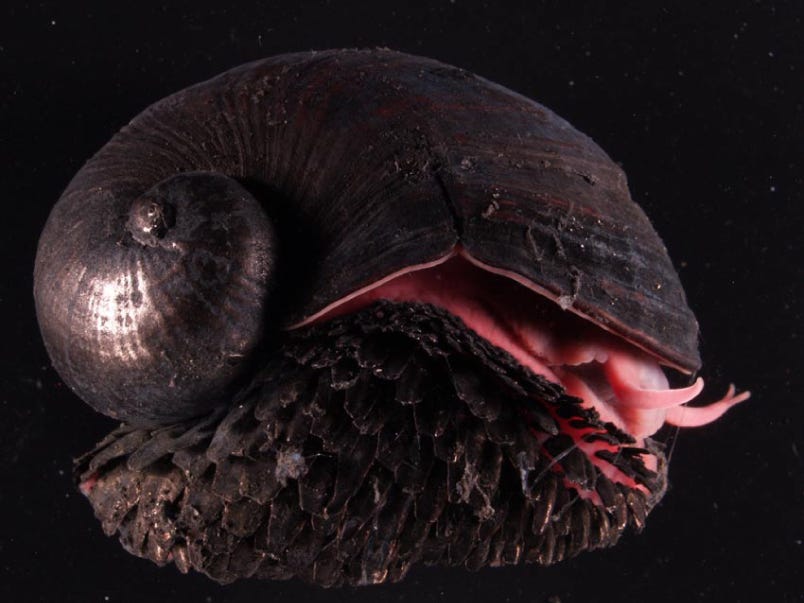
Photo from Nakamura et al. 2012 PLoS ONE
Let me tell you three things about these snails, each completely mind-blowing: they are metal, in both shell and armored foot; they probably don’t eat, at least not in any normal sense; and the entire area where they are found is tiny and under threat.
First, they are reinforced with metal. Their shell is coated in a layer of iron sulfides, providing immense protection. Not only that, but as they grow they cover their foot in scaly armor. Overlapping scales give them a third name, the sea pangolin. Each scale, called a sclerite, is also infused with iron sulfides. If you have ever handled pyrite, also called fool’s gold, you know it is hard, metallic, with sharp edges. This is one of the ingredients in the armor and shell of this snail.
Second, they do not seem to eat. They have a heavily simplified digestive system, and no jaw or salivary glands. But part of their esophagus opens into an immense pouch, taking up nearly 10% of their body volume. Inside this pouch they host sulfur-eating bacteria. The pouch is packed with blood vessels, probably to supply their bacterial partners with both food (hydrogen sulfide) and oxygen; to that end, they have a single, tremendously large gill to filter scarce oxygen from the deep water. They host the bacteria, tend to them, and the bacteria, feeding on energy-rich chemicals that spew from the vent, supply energy to the snail.
Finally, these snails are completely dependent on one of the Earth’s rarest habitats. It seems very likely that the total area with suitable vents for these snails is tiny, about the size of a small city park. Over eons, they have survived there, isolated and invisible to the outside world. Now, of course, they are under threat. There are minerals that humans want in these vents. Deep sea-mining could easily wipe them out. Of course, people are always more creative than you expect:
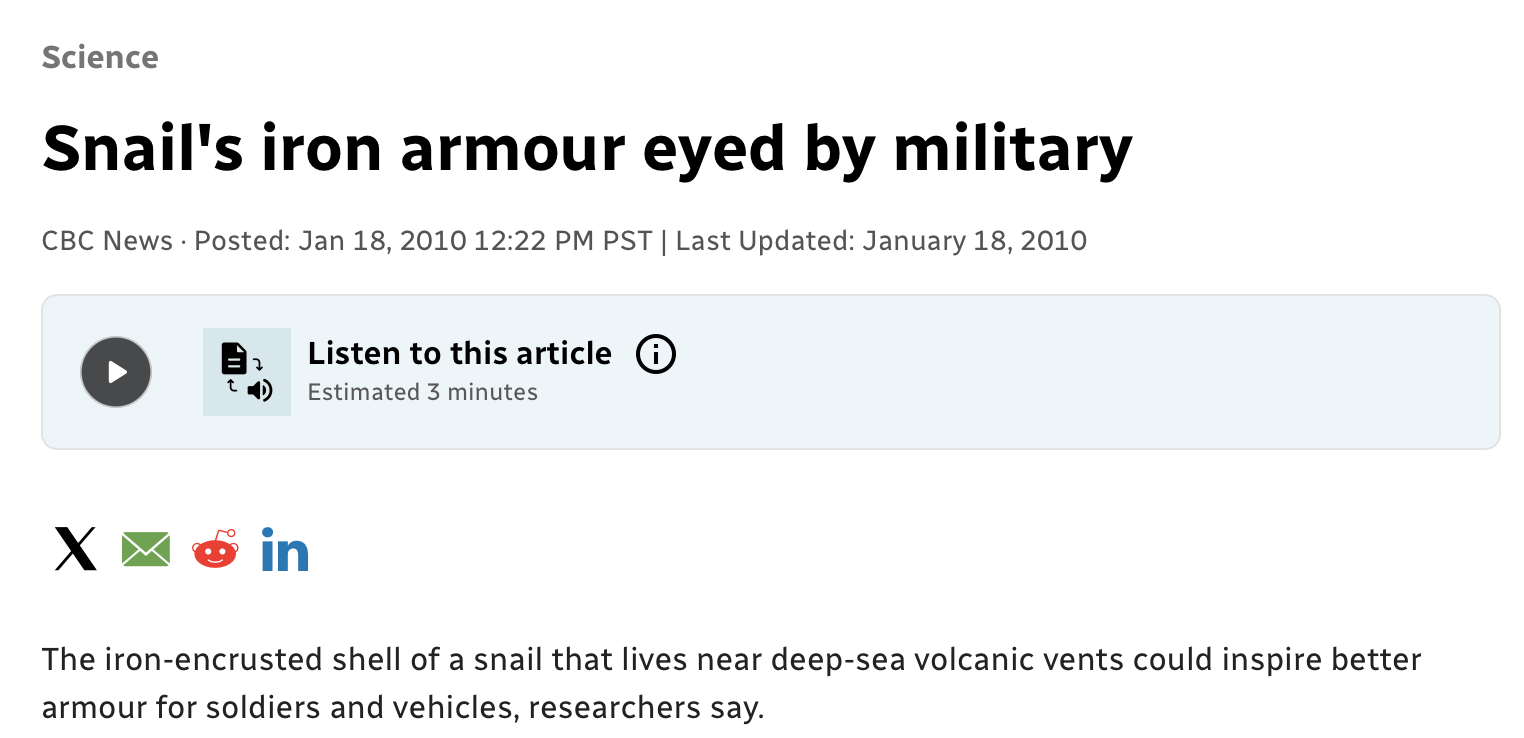
Typical human thoughts about the sea pangolin.
So, here’s to the volcano snail, the sea pangolin, the scaly-foot; armored creature of the deep, farmer of the vents. Together with its symbiont bacteria, it lives in darkness, feeding off the chemical heat of the Earth. It is a wonder that such a thing exists at all. We have just discovered it, and already we might kill it forever.
I hope we can let it live in its strange little world.